
Lovebugs — By Jennifer Miller, County Agent
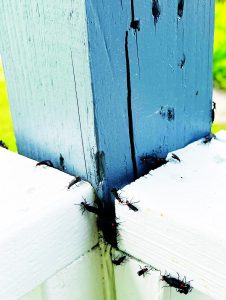
South Georgia is notorious for being associated with bugs. Most folks are complaining about gnats. This time of year, we switch gears to lovebugs.
They lightly land on your arms, face and head as you go about your business outside and make a huge mess of your car grill and windshield.
Lovebugs are part of a large group of insects known as March flies. There are over 200 types of March flies found in the world. But only two occur in the United States. Lovebugs migrated from Central America up into Texas and eventually to our part of the country sometime after World War II. Adult lovebugs do not sting or cause any type of disease; they are just annoying. They get their name from the mating flights that occur twice a year around May and September. Each flight lasts about four weeks. You will see the red and black bugs often in pairs mating, or on their “honeymoon.”
Soon after lovebugs become adults the male and female unite and remain connected for many hours, often still in flight. During this time not only does mating take place, but the male also transfers nutrients to the female so she can produce healthy eggs. Once she lays 150-600 eggs she soon dies. The female lifespan is only 2 to 3 days. Eggs are laid on grass clippings and decaying plant material. When the larvae hatch, they feed on this material and aid in decomposition.
Sprays for lovebugs are not practical because it only keeps the insects cleared away from one spot for a short period of time. Lovebugs have many predators; birds, armadillos, small invertebrates, and other insects.
This September we seem to have a dense lovebug flight. Numbers of lovebugs go up and down each year, based off environmental conditions and natural predator populations. Back in the late 60’s and early 70’s populations of lovebugs got so high they were a public safety issue completely blocking windshields of moving vehicles. The smashed insect itself is not a problem for car paint; the issue is seen after the guts bake onto the paint in hot temperatures. During this time of year, it is advisable to wash them off frequently if you are concerned about permanent damage.
As you enjoy the outdoors this month as we hopefully begin to transition to milder temperatures, try not to be angry at these small honeymooning bugs. After all, the Lord has a purpose for everything under the sun, lovebugs too.
If you have a question about anything agriculture related send it to me. You can; email jenthomp@uga.edu send a text to 912-253-5356 or call the office at 912-375-6648. Please put Ask Your ANR Agent in the correspondence. You can also send a letter to P.O. Box 643, Hazlehurst, Georgia 31539. I look forward to hearing from you! For general info -visit us online at: http://extension.uga.edu/county-offices/jeffdavis.html or at the Plow Points Ag Blog: http://blog.extension.uga.edu/plowpoints/
